The Software Layer That Turns Storage Into an Asset
Software architecture drives commercial returns. The proprietary Zyntra EMS moves storage from unmanaged hardware backup into a hands-off, yield-generating, remotely managed asset.
Without third-party licensing, or the data exposure that comes with it.
Introduction
Generation, demand and battery availability, coordinated at once.
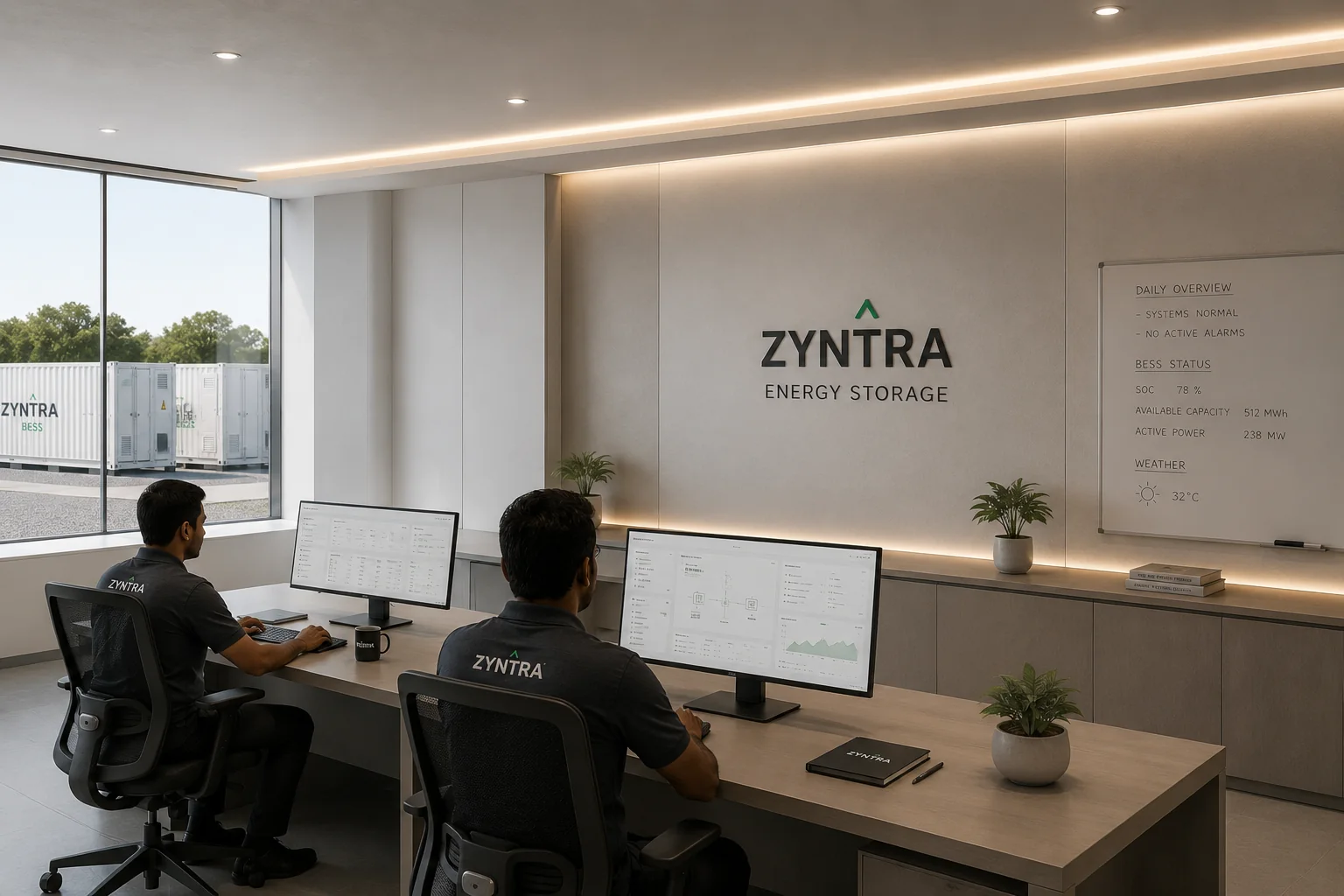
The in-house EMS coordinates local hybrid generation, building or facility demand, and battery availability simultaneously — entirely in-house, with no third-party software licence and no data leaving a boundary Zyntra doesn’t control.
Smart Energy Management
Two mechanisms that move money.
01
Time-of-Use tariff arbitrage
The software monitors local utility rate tables, charging automatically during low-cost off-peak periods or from mid-day solar generation, then discharging during peak evening contract brackets.
35–55%
Lower monthly billing
Typical reduction in standard monthly billing from automatic tariff arbitrage, with no change in operating habits.
02
Peak shaving
Fixed demand fees tied to a facility’s single highest 15-minute load surge routinely account for 40% to 50% of a commercial power bill.
The EMS monitors input lines continuously, discharging instantly to absorb large inductive spikes — HVAC start-ups, machine cycling — to lower the customer’s contracted demand tier before the surge registers.
Remote Management
A site, not just a battery.
This is the direct mechanism by which the EMS reduces ongoing O&M cost — not just backup runtime.
Charge and discharge scheduling, load monitoring and fault alerting all run centrally, which means a distributed portfolio — multiple homes, offices, or containers — can be operated from one dashboard rather than requiring a technician on-site to check status or adjust behaviour.
Routine operations that would otherwise mean a site visit become a remote configuration change.
Data Sovereignty
Remote doesn’t mean exposed.
All EMS operations run behind end-to-end data encryption, local network security safeguards, and dedicated firewalls. Operational telemetry — charge state, load data, site performance — stays within a boundary Zyntra controls directly, with no third-party cloud dependency and no data routed through infrastructure outside that boundary.
Why it matters
For a public utility or a facility with its own compliance obligations, this is the specific property that makes remote management acceptable in the first place.
Sovereign telemetry is the difference between a remotely managed asset and a remotely exposed one.
Compliance readiness. The EMS architecture is modular and software-upgradable, communicating over open, standard protocols rather than a proprietary closed stack. As tariff structures, grid-codes, or reporting requirements change, the response is a software update to the existing installed base — not a hardware replacement programme.
Technical Specification
The same architecture, scaled to the deployment.
The small-format pack and the infrastructure enclosure run the same control philosophy at different speeds and topologies.
| Control component | ZYNTRA — Home & Office small format pack | ZYNTRA+ — Infrastructure enclosure |
|---|---|---|
| BMS communication | Native CAN / RS485 | High-Speed Modbus TCP / EtherCAT array |
| Balancing topology | Active cell-level resistive balancing | Dynamic multi-tier active transformer grid |
| EMS tracking speed | Localised real-time internal polling loops | Sub-millisecond telemetry sampling (<20ms FFR) |
| Sovereign security | Encrypted app sync with privacy protections | End-to-end local network firewalls |
Every Zyntra and Zyntra+ product runs on this EMS, scaled to the deployment.
The EMS schedules a pack the BMS has already made safe, built on LFP chemistry.
Get started
Talk to Our Engineers
Protocol support, dashboard access, or how sovereign telemetry maps onto your own compliance obligations — ask directly.