Offices
One system covering a floor of desks, the lighting circuit and the server cupboard through a cut.
ZYNTRA — Small-Format
Residential ESSHome battery backup, quieter and lower-cost Commercial ESSOffice & retail backup, sized for a workday ZyntraPODAll-in-one battery & inverter View All ZYNTRA ProductsZYNTRA+ — Infrastructure Scale
Utility BESSGrid-scale storage for public infrastructure C&I BESSIndustrial & IPP-scale storage View All ZYNTRA+ ProductsLFP battery storage sized for a workday’s power draw — for offices, retail premises and clinics.
The same chemistry, the same protection hardware and the same support terms as our residential range. The only thing that changes is how much capacity is on the wall.
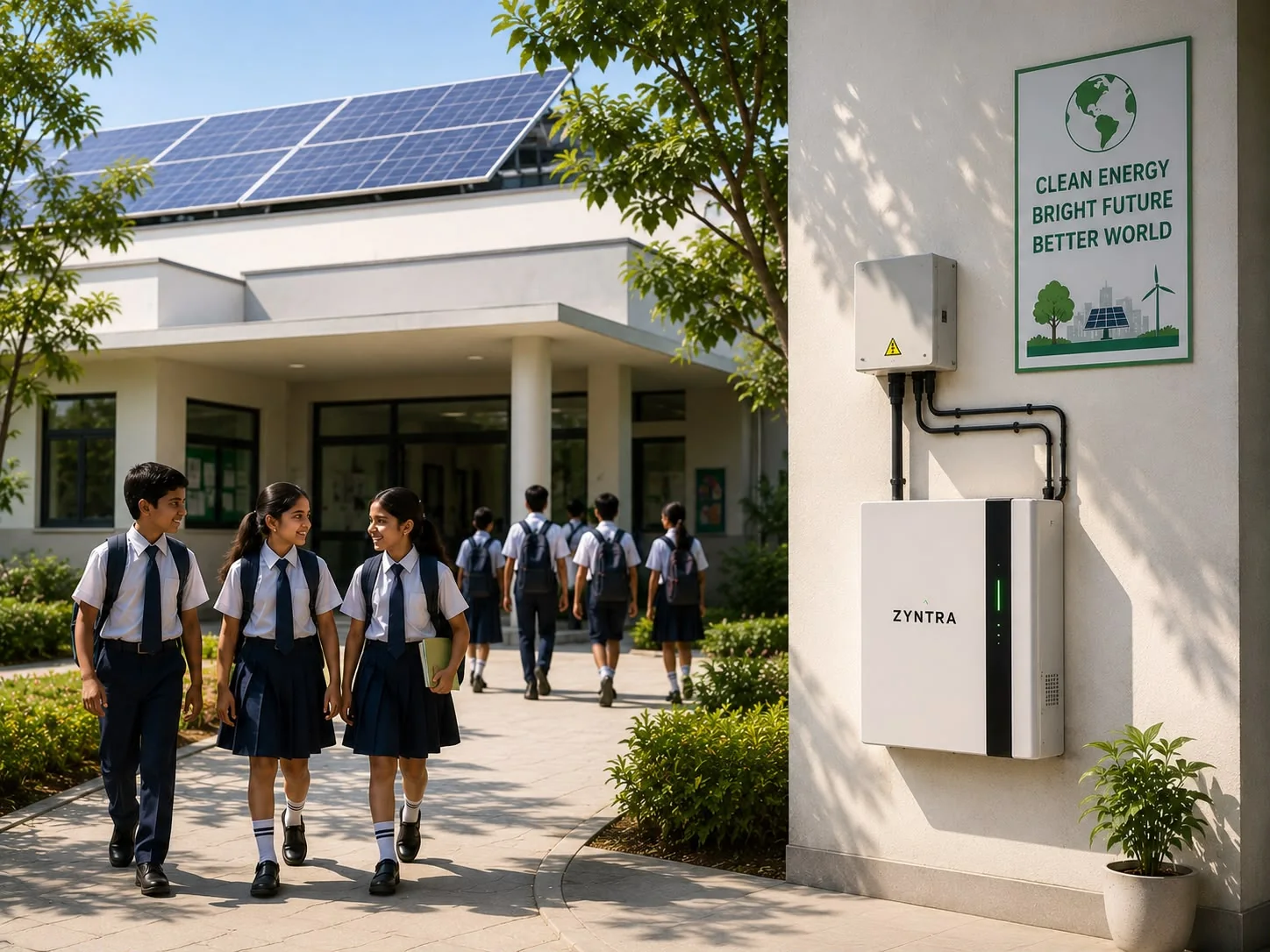
Overview
Lost trade, a cold chain at risk, a waiting room with nothing running. ZYNTRA Commercial ESS is sized against a workday’s actual load — it carries the circuits that keep the business open, and it lowers the bill for the rest of the month.
Sizing starts from your last twelve months of bills and how much of the day the premises is actually occupied — not from a product catalogue. Our team does that sizing before quoting anything.
If you’d rather have the battery, inverter and energy control arrive as one factory-matched unit, see ZyntraPOD. For homes and villas, see Residential ESS.
Applications
One system covering a floor of desks, the lighting circuit and the server cupboard through a cut.
Lighting, refrigeration and the point of sale stay up, so the shop keeps trading through an outage.
Steady power for the circuits a clinic can’t run without — paired with your inverter, or with ZyntraPOD for zero-gap transfer.
Holds midday generation instead of exporting it at a low feed-in rate, then serves the premises from it later.
Benefits
01
A premises that trades from 09:00 to 21:00 has a different load shape from one that closes at 17:00, and both are different again from a clinic running diagnostic equipment in short bursts. Sizing starts from your last twelve months of bills and how much of the day the premises is actually occupied.
An installation partner then checks the space, the board and the circuits you want backed up before anything is quoted.
02
Time-of-day slabs are spreading across state discoms, and the same unit costs materially more at 20:00 than at 13:00 — a gap that is widening, not closing. The onboard energy management layer reserves capacity ahead of the evening block so the highest-priced units are never drawn from the grid.
No one on site has to manage it, and no one has to remember to switch anything over.
03
Essential circuits carry straight through an outage — no start-up delay, no fuel, no noise, and no separate generator to maintain. Where a DG set stays on site for longer outages, its running hours drop sharply.
04
A clinic, a school or a retail premises is quoted on the identical LFP chemistry, the identical protection hardware and the identical support terms as a two-bedroom flat. The only thing that changes is how much capacity is on the wall.
Where the saving comes from
The range below reflects installations pairing rooftop solar with a correctly sized ZYNTRA system. Actual saving depends on your tariff structure, array size and consumption pattern.
Solar self-consumption
Holds midday generation in the battery instead of exporting it at a low feed-in rate, then serves the premises from it later.
10:00 – 17:00
Time-of-day arbitrage
Charges from the grid when the tariff slab is cheapest and discharges when it is most expensive. Fully automatic.
Daily, unattended
Peak-tariff shaving
Reserves capacity ahead of the evening block so the highest-priced units are never drawn from the grid.
18:00 – 23:00
Outage cover
Carries essential circuits straight through a cut — no start-up delay, no fuel, no noise, no separate generator to maintain.
Whenever the grid drops
35–55%
Lower monthly bill
Typical reduction for a premises pairing rooftop solar with a correctly sized ZYNTRA system — with no change in operating habits required.
What changes on the bill

The same six, at any size
Identical chemistry, identical protection hardware, identical support terms. The specification does not scale down for a smaller premises, and it does not get quietly cheaper for a larger one.
Technical Specifications
These are the models sized for a workday’s draw and for pairing with rooftop solar. Which one you need comes out of the sizing exercise, not out of this list — and the full specification for every model in the range, including the smaller 12.8 V and 24 V packs for light backup loads, lives on Residential ESS.
ZYN-S100
5 kWh
Solar Home Setup / Small Office
ZYN-S150
7.5 kWh
Larger Solar Home / Small Commercial
ZYN-I160
7.7 kWh
High-Durability / Extreme Climates
One lit cell = 0.25 kWh of usable capacity. All three carry the 5-year onsite warranty and the same 8,000-cycle rating.
* ZYN-I160 uses the same LFP chemistry as the rest of the range, built around an advanced thermal management system and an upgraded IP67 enclosure for faster charging and harsher outdoor conditions — not a different battery chemistry, just a ruggedised version of it. It is the model specified for unconditioned plant rooms, outdoor enclosures and high-ambient sites.
Battery technology
Lithium iron phosphate (LiFePO₄) — chosen for stability over energy density. Stable to +270 °C, zero cobalt, zero nickel.
Protection layer
Continuous voltage, temperature and cell-balance protection enforced in hardware by the BMS — independently of the software layer and of any network connection.
Energy management
Automatic tariff arbitrage, peak-tariff shaving and remote monitoring via the EMS layer.
Rated cycle life
8,000 cycles to greater than 80% of day-one capacity.
Health tracking
Tracked across the full rated life, not only the warranty window.
Warranty
5 years onsite. An engineer attends the premises; nothing is shipped anywhere.
End of life
Buy-back option at a fair price when the premises upgrades.
Commercial ESS Spec Sheet
Full specifications, enclosure ratings, protection architecture and warranty terms.
What happens next
01
Share your last few electricity bills and whether you already have solar. That is enough for a first view.
02
An installation partner checks the space, the board and the circuits you want backed up, then sizes the system.
03
Mounting, wiring and integration with your inverter and main line, handled end to end by the same partner.
04
Commissioning, a walkthrough of the app, and lifecycle health tracking from the first cycle onwards.

Before you decide
Storage does not pay back equally on every tariff. If your slab structure or consumption pattern does not yet justify a battery, we will say so — and tell you what would need to change for it to make sense.
Why ZYNTRA
01
Every ZYNTRA battery is built in India, for Indian homes, offices and commercial premises — not imported, rebadged, or an afterthought in someone else’s global product line.
02
A new 3 GWh manufacturing line is already underway, built to keep up with demand across India and Asia without cutting corners on quality.
03
If something goes wrong, our team comes to you — not a courier label you print yourself and a long wait for a replacement.
04
Our installation partners handle everything from the first site visit to switch-on — no guesswork, no risk to you or your premises.
05
Battery health is tracked across its full rated life — up to 8,000 cycles — not just the warranty window.
06
Your ZYNTRA battery holds real value even after years of use — when it’s time to upgrade, we’ll buy it back at a fair price.
FAQs
From your last twelve months of electricity bills and how much of the day the premises is actually occupied. An installation partner then visits to check the space, the distribution board and the circuits you want backed up. Sizing happens before a quote, not after.
Whichever you choose. Most commercial installs back specific circuits — POS systems, servers, refrigeration, essential lighting — rather than the whole distribution board, since sizing for 100% coverage is rarely the economical choice. Your installation partner maps this out during the site visit.
For outages up to the runtime you size for, yes — and it starts instantly with no fuel, no fumes and no run-in period. For very long or frequent outages beyond your storage capacity, most sites keep a generator as a second layer rather than replace it outright.
Commercial ESS pairs with your site's existing or planned inverter — it's a battery system, not an all-in-one unit. If you'd rather not manage that pairing separately, ZyntraPOD bundles both into one box.
Sizing happens before a quote, using your actual twelve months of bills — if the numbers don't work for your tariff structure, that shows up in the sizing conversation, not after installation. Talk to a storage expert before committing to a configuration.
Yes — LFP is the most thermally stable lithium chemistry available, in a sealed enclosure with continuous BMS protection. It's the same reasoning that makes it standard for hallway cupboards and utility closets in occupied homes.
Related
Battery, inverter and smart energy control in one factory-matched unit, with instant switchover for equipment that can’t tolerate a gap.
All-in-one home inverter batteryThe full small-format range, including the 12.8 V and 24 V packs for lighter backup loads.
Home battery backup systemWhy the chemistry is lithium iron phosphate — stability over density, zero cobalt, zero nickel.
LFP battery technology explainedGet started
We size against your actual consumption before quoting anything — and we’ll tell you plainly if storage doesn’t pay back on your tariff yet.