Uptime Engineered, Not Just Backed Up
Engineered for mission-critical uptime. Built for power quality, carbon reduction and dependable performance under compute load.
What a facility operator and their EPC partner are actually weighing.
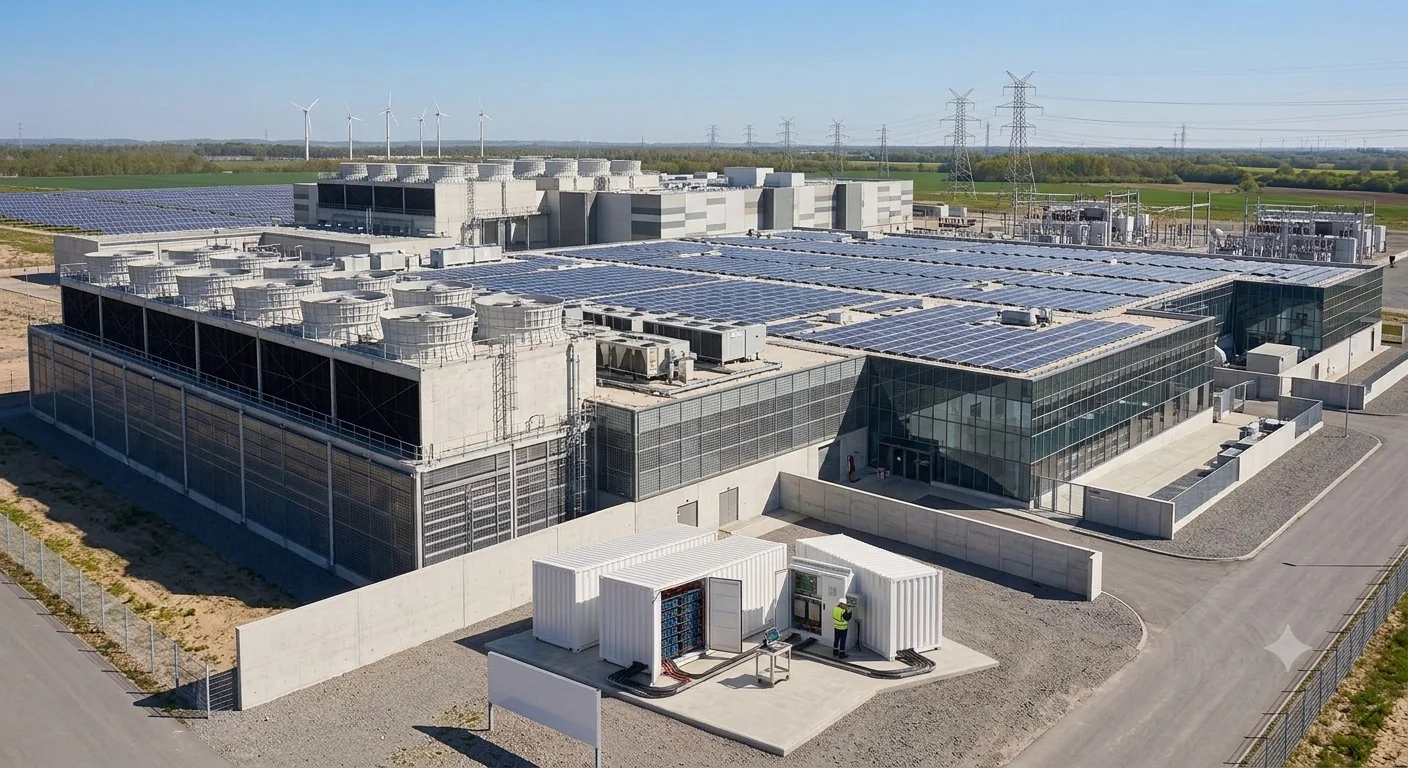
Industry Challenges
The problem, as the buyer states it.
What a facility operator and their EPC partner are actually weighing.
01
Compute load volatility
AI and machine learning workloads generate power spikes that push facilities beyond contracted demand limits, unpredictably.
02
Diesel dependency versus carbon targets
Standard backup runs on diesel spinning reserve, sitting directly against Scope 2 carbon reduction commitments.
03
Idle capacity as pure cost
Standard backup generates zero return until a grid failure occurs — insurance, not an asset.
04
Power quality sensitivity
Compute hardware requires absolute phase stability; a voltage sag a factory floor shrugs off can take down a server rack.
EPC Contractor
The EPC's Tier certification problem
Design validation has to meet Tier layout requirements precisely, on a schedule where delay is not an option.
How ZYNTRA+ Solves Them
Five platform capabilities, applied to this segment.
01
Energy Arbitrage
ZYNTRA+ charges during off-peak windows or stores daytime solar generation, discharging during peak tariff periods to cut structural energy cost.
02
Peak Shaving
Container blocks monitor input loads continuously, discharging instantly to absorb transient compute spikes — lowering contract demand penalties without over-provisioning capacity for rare events.
03
Grid Stability
Smart bidirectional inverters respond within sub-millisecond timelines to grid anomalies, correcting voltage sags and harmonic distortion before they reach server racks.
04
Regulatory Readiness
Where utility response programmes are available, the same backup capacity can participate in frequency regulation and grid-balancing mechanisms — converting idle insurance into an active revenue line as those programmes evolve.
05
Engineering Flexibility
Design validation moves cleanly from modelling to physical layout under strict execution discipline, meeting Tier layout requirements precisely, with standardised container configurations integrating into existing UPS and substation infrastructure.
Recommended Products
The specification lives on the product page.
This page makes the case for the segment. The engineering proof — form factors, configurations, protection architecture — sits where it belongs.
Utility BESS
For larger-scale facility deployments.
Utility scale battery energy storage systemC&I BESS
For smaller-footprint colocation sites.
Commercial and industrial battery storageConfiguration depends on facility scale; both integrate with existing UPS and substation infrastructure with minimal site modification.
Why Us
What carries the project after the tender closes.
01
Engineering Support
A specialised execution team carries design validation through to physical site layout under Tier-specific requirements, not a generic commissioning process.
02
Proprietary In-House EMS
Balances utility supply, battery state-of-charge, and facility compute loads in the background, without third-party licensing.
03
Make in India
Domestic assembly insulates expansion timelines from import risk, backed by an upcoming 3 GWh manufacturing line matched to hyperscale rollout demand.
04
Data Protection
Encrypted telemetry and local network safeguards meet corporate compliance profiles as strictly as public security requirements.
05
Life Cycle Support
Rated for up to 8,000 charge cycles under continuous non-stop power cycling, with dedicated on-site field service protecting uptime for the life of the asset.
FAQ
Frequently asked questions
Yes — deployments are led by a dedicated execution team carrying design validation through to physical site layout under Tier-specific requirements.
The EMS monitors input lines continuously and discharges instantly to absorb sharp inductive or compute-driven load spikes, before they register against a demand tier or trip protection — the same peak-shaving mechanism used across the commercial range, sized for data-hall load profiles.
Yes — between outages, the same capacity reserved for backup can run time-of-use arbitrage and peak shaving, so it's earning its keep rather than sitting idle until it's needed.
It reduces runtime hours on generators by absorbing short interruptions and load spikes that don't require a full diesel start — for facilities tracking Scope 2 reduction, that's fewer generator-hours logged, though the specific carbon accounting depends on your site's baseline and grid mix.
Get started
Speak with Our Engineering Team
Engineered for mission-critical uptime. Built for power quality, carbon reduction and dependable performance under compute load.