Containerised BESS for Grid-Scale Deployment
Weatherproof, container-integrated battery storage engineered for substations, grid-scale renewable parks, and government infrastructure programmes.
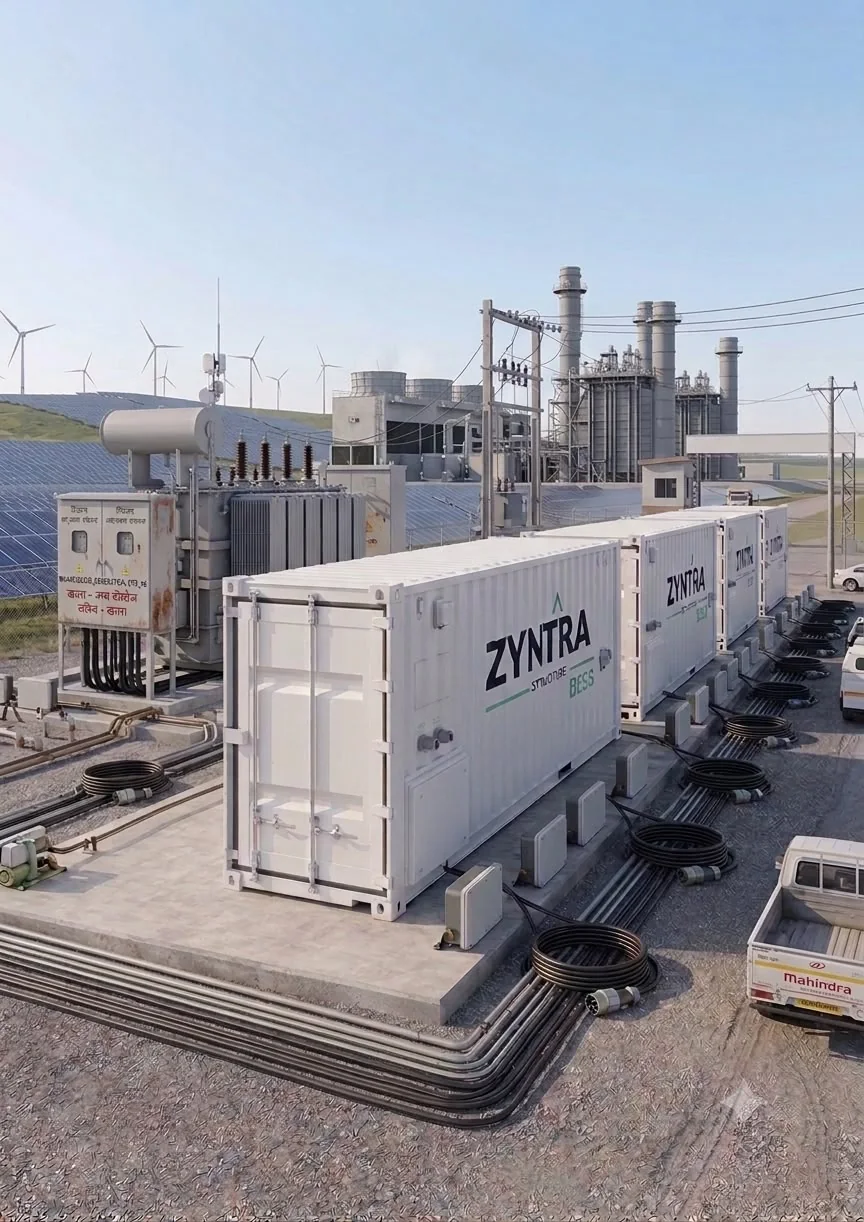
From a single unit to a multi-container array.
Intro
One enclosure. Racks, conversion and controls, pre-integrated.
Utility BESS pairs LFP battery racks, power conversion cabinets, and system controls inside a single weatherproof enclosure — engineered for fast site deployment and grid-code compliance across utility and government-scale renewable projects.
Every capability below is a platform characteristic, not a configuration extra.
Capabilities
Five capabilities, native to the platform.
01
Arbitrage
Energy Arbitrage Optimisation
LFP’s high round-trip efficiency and low self-discharge mean every kWh stored is a kWh worth dispatching. Utility BESS is engineered for rapid, high-throughput daily cycling — capturing off-peak or sub-penny power and dispatching it during peak-tariff windows with minimal thermal degradation or energy loss.
02
Peak Shaving
Demand Charge Management
The integrated power conversion system (PCS) and edge-EMS respond to load spikes in sub-millisecond time. Utility BESS clips peak demand instantly, keeping connected infrastructure safely under contracted demand limits — avoiding peak-load penalties entirely rather than mitigating them after the fact.
03
Sovereignty
Energy Independence & Resilience
Seamless microgrid islanding and black-start capability are built into the BMS/EMS from the ground up, not layered on top. Utility BESS gives critical infrastructure complete operational autonomy — isolating into a self-sustaining power island the instant grid instability, rolling blackouts, or power quality sags threaten continuity.
04
Grid Balance
Ancillary Services & Stability
Active and reactive power control (P/Q control), frequency regulation and voltage support are native to the platform. Utility BESS converts passive storage into a dynamic grid asset — rapid frequency response (RFR) and synthetic inertia that meet strict utility interconnection codes rather than merely satisfying them on paper.
05
Changing Regulatory Landscape
Future-Proof Compliance
A modular, software-upgradable EMS architecture running on open communication protocols — Modbus, DNP3, IEC 61850 — means Utility BESS adapts as open-access rules, Time-of-Day structures and carbon reporting requirements shift. Updates deploy over the air, not through a hardware overhaul.
Specifications
The engineering detail, where it belongs.
Utility BESS is one of two deployment cases for the ZYNTRA+ range. The models, their capacities and their enclosure ratings are listed once for the whole line rather than repeated per page.
Model range
The ZYNTRA+ range
Every ZYNTRA+ model with capacity, form factor and enclosure rating, filterable by form factor.
View the catalogueFull specifications
Technical datasheet
Electrical architecture, thermal management, ingress classes, fire mitigation, efficiency and lifecycle — every parameter.
Open the datasheetEngineered for EPC Integration
Utility BESS is built on a fully customisable bill of materials — configured to your specified inverter pairing, auxiliary transformers, and site layout rather than a fixed factory spec. Pre-engineered sub-assemblies and pre-tested container integration reduce on-site civil work and labour time, protecting both implementation cost and commissioning schedule. Production and delivery sequencing can be synchronised directly against your project’s critical path, with local technical support available from load simulation through electrical protection coordination review.
Utility BESS Full Datasheet
Container specifications, PCS pairing, protection coordination and grid-code compliance data.
Why Us
Domestic supply, in-house control software, field service that shows up.
Up to 8,000
Charge cycles
Rated under continuous, non-stop grid cycling.
3 GWh
Manufacturing line
Already underway in India to support programme scale.
Make in India
Domestic integration
Cell packaging and system integration, not rebadged import.
01
Make in India
Domestic cell packaging and system integration eliminate dependency on volatile overseas supply lines, keeping levelized storage costs stable across multi-year public programmes.
02
Proprietary In-House EMS
Our custom, in-house Energy Management System coordinates multi-container installations autonomously — managing Fast Frequency Response and dynamic peak shaving without third-party licensing dependencies or the security exposure that comes with them.
03
Sovereign Data Protection
End-to-end telemetry encryption, local network security safeguards, and secure hardware firewalls keep operational data and system telemetry fully contained within authorised parameters.
04
Engineering Support
Every deployment is led by a dedicated engineering and EPC execution team, carrying the project from single-line simulation through physical field layout under strict technical metrics and grid-code alignment.
05
Life Cycle Support
Rated for up to 8,000 charge cycles under continuous, non-stop grid cycling, backed by dedicated on-site field service teams operating from regional logistics nodes — not a distant service desk.
Intersecting Pages
Where this page connects
- Solutions > Utilities The segment-level case for grid-scale storage, before the product-level specification.
- Products > C&I BESS The sibling product line for commercial and industrial-scale deployment.
- Technology Hub > EMS, BMS The engineering detail behind the EMS and BMS referenced throughout this page.
- Products > ZYNTRA+ hub Back to the product line overview.
FAQ
Frequently asked questions
Yes — native P/Q control, frequency regulation and voltage support mean the platform can provide rapid frequency response and synthetic inertia wherever ancillary markets are available, not just baseline storage and discharge.
Grid-code compliance is engineered in at the control-system level, not bolted on — and because the EMS and BMS are Zyntra's own, in-house software, control logic can be updated as grid codes evolve without waiting on a third-party vendor's release cycle.
Black start capability is native to the range — the system can energise a dead bus and restart independently of the grid, then resynchronise once supply returns. Exact behaviour is configured per project against the site's protection scheme.
Yes — container-scale deployments are engineered per project, not sold off a fixed configuration. Transformer and inverter matching happens during the engineering scope, ahead of a commercial quote.
Infrastructure-scale ZYNTRA+ installations are covered under standalone enterprise project contracts rather than the public residential warranty policy — coverage terms, response SLAs and spares availability are agreed as part of the commercial scope for each project.
Specify
Specify Utility BESS for Your Project
Our engineering team can review your site requirements and configuration constraints directly.