Engineered Storage for Industrial Sites & Independent Power Producers
Engineered for industrial and IPP assets. Built for yield protection, regulatory agility and dependable performance under load.
What's actually costing money or threatening yield, from where the buyer sits.
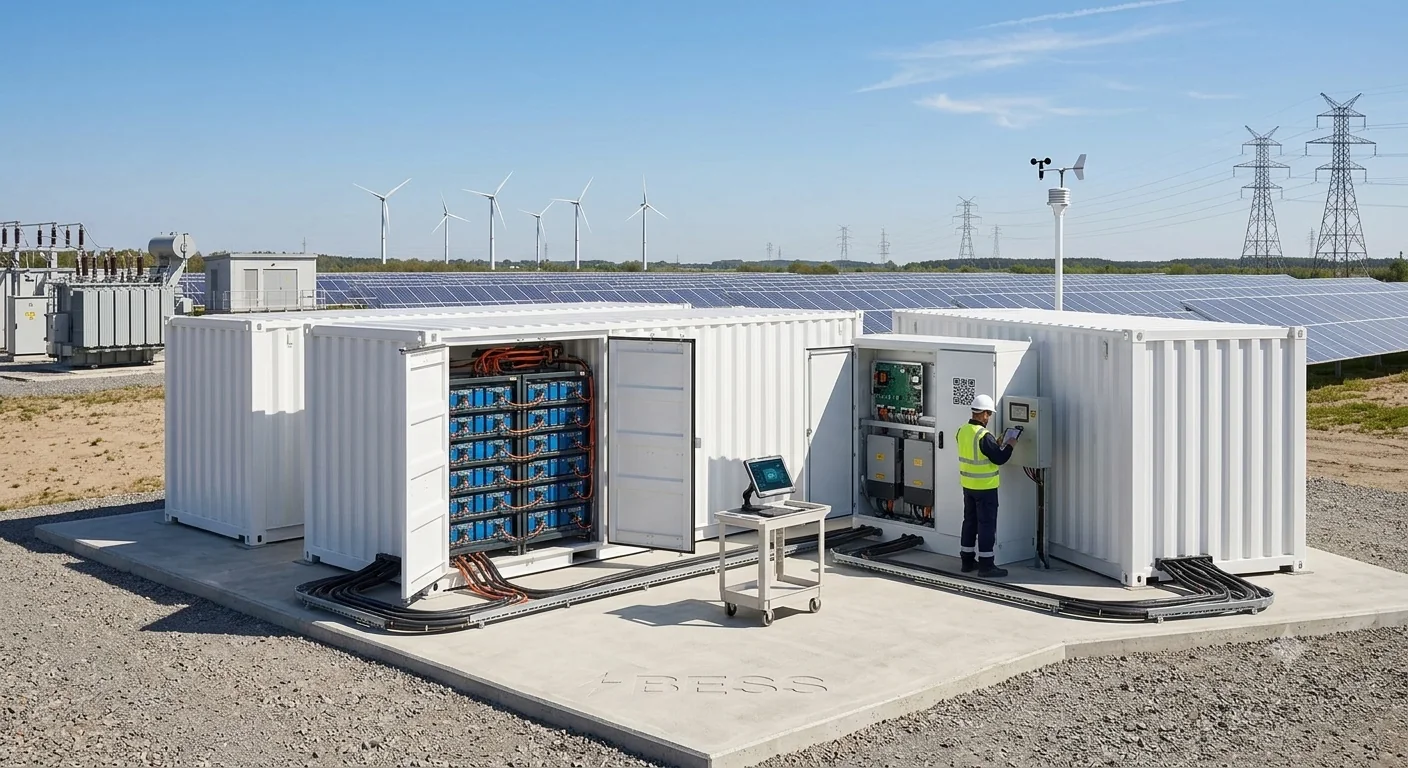
Industry Challenges
The problem, as the buyer states it.
What's actually costing money or threatening yield, from where the buyer sits.
01
Demand charges eating margin
A single load spike — a motor start, an HVAC cycle, a production line startup — can set a facility's contracted demand tier for the whole billing cycle.
02
Stranded generation
For an IPP running a private solar park, output that exceeds evacuation limits at midday is revenue discarded, not deferred.
03
Regulatory ground shifting underfoot
Open-access banking rules across Asia are tightening from liberal monthly settlement toward hourly or real-time balancing.
04
Power quality risk to sensitive plant
Grid instability damages equipment that can't tolerate voltage sags, beyond just the cost of outage time.
EPC Contractor
The EPC's integration problem
A co-located generation asset or industrial retrofit needs storage built around the existing inverter and site layout, not a standard factory configuration.
How ZYNTRA+ Solves Them
Five platform capabilities, applied to this segment.
01
Energy Arbitrage
LFP's high round-trip efficiency and low self-discharge mean stranded solar generation doesn't have to stay stranded. ZYNTRA+ captures high-insolation output that exceeds evacuation limits at the source, dispatching it into merchant markets or high-value Time-of-Use windows.
02
Peak Shaving
The integrated power conversion system and edge-EMS respond to load surges in sub-millisecond time, clipping peak demand before it registers against the contracted limit — avoiding penalty charges entirely.
03
Grid Stability
Native P/Q control and frequency regulation, alongside islanding and black-start capability, give co-located industrial plants and IPP assets operational autonomy independent of grid instability.
04
Regulatory Readiness
As open-access regimes shift, the software-upgradable EMS — built on Modbus, DNP3 and IEC 61850 — adapts via over-the-air update, protecting assets from penalty exposure as the rules change.
05
Engineering Flexibility
The bill of materials is built per-project, matched to your existing inverter pairing and site layout rather than a fixed SKU.
Recommended Products
The specification lives on the product page.
This page makes the case for the segment. The engineering proof — form factors, configurations, protection architecture — sits where it belongs.
Why Us
What carries the project after the tender closes.
01
Engineering Support
Technical support spans early load simulation, electrical protection coordination review, and grid-code compliance alignment — from initial specification through handover.
02
Proprietary In-House EMS
Remote monitoring, scheduling and command authority over distributed assets from a centralised dashboard — no third-party licensing dependency.
03
Make in India
Domestic integration and testing insulate project timelines from cross-border supply risk, backed by an upcoming 3 GWh manufacturing line.
04
Data Protection
Operational telemetry and control configurations remain contained within authorised parameters, secured end-to-end.
05
Life Cycle Support
Rated for up to 8,000 charge cycles under continuous high-throughput operation, with structured Operations & Maintenance after handover.
FAQ
Frequently asked questions
By storing generation locally, ZYNTRA+ lets asset owners match settlement schedules directly through a software-upgradable EMS — insulating projects from regulatory shifts rather than reacting after the fact.
The hardware supports it — grid-forming controls with fast frequency response are standard across the ZYNTRA+ range. Whether a specific market allows a given site to register and participate is a regulatory question for that project, which our engineering team reviews during scoping.
Yes — industrial deployments are engineered per site, not sold as a fixed package. Existing inverter and layout constraints are part of the engineering scope before a configuration is proposed.
Peak shaving: the EMS monitors the site's load continuously and discharges to absorb large inductive spikes — HVAC start-up, machine cycling — before they register against the facility's contracted demand tier, which is what the fee is actually calculated on.
Get started
Model Your Energy Savings
Engineered for industrial and IPP assets. Built for yield protection, regulatory agility and dependable performance under load.